
Memory Archaeologist
Why digging into the past can harm your process of deconstructing fear

My friend Mika wanted to talk to me about her process of fear deconstruction. She found some of my notes and posts about a perspective on linear time that shook some of her concepts.
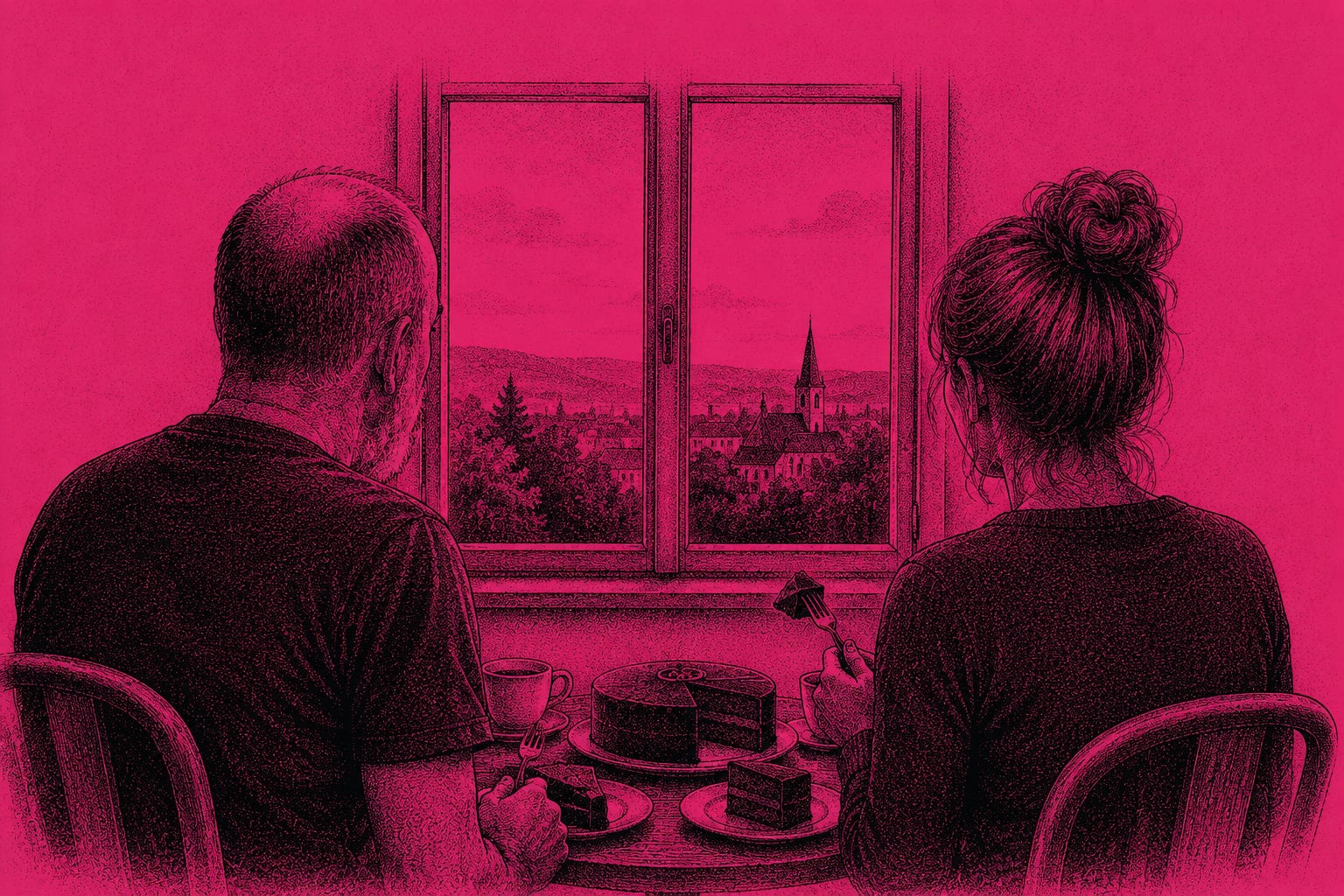
We agreed to meet in Ljubljana and used the opportunity as an excuse to share a Sacher Torte at one of my favorite coffee houses.
Let me share with you some context:
The theory of Deconstructing Fears from my book includes finding old patterns that no longer fulfill a function, finding their futility, and therefore dissolving their influence on our behavior.
In the book, I presented the idea of finding ourselves inside a brick fortress. Each brick represents a fear pattern created in the past to defend us from a perceived threat. Deconstructing Fears is the process of identifying patterns that no longer serve us, therefore “deconstructing the fortress” step by step. The metaphor suggests that fewer bricks around us will allow us to experience more freedom, opportunity to act, less resistance, and more joy.
Mika heard me saying that from one perspective, the past doesn’t really exist. So, as you can imagine, she found something wrong with the process I proposed in my book.
Let’s revise the idea of non-linear time within the context of this conversation.
From the linear perspective, time started long ago, it continues, and projects towards the future. The present appears to be insignificant because every millisecond that passes moves the present into the past. It feels like the future is imminent at every step, but it passes too fast from the present to the past.
From that perspective, our memories become evidence of events that “happened”.
The non-linear perspective establishes that we only have evidence of the present, because it is the only moment when we can perceive, experience, process, and investigate. In other words, the past and the future don’t exist.
I see the idea of an eternal present as an emergence, a flow of reality from nothingness to nothingness. The present is the only fundamental moment.
Our conversation went obviously philosophical. Mika was asking, if the past doesn’t exist, how could I examine it, find the source of my fears, and then how would I get that sense of freedom that happens when I identify the pattern?
Mika was feeling stuck, and her work on fears came about as that stuckness became a repeating pattern. In the present, she found herself feeling unworthy of a better job, better conditions. She noticed how often she compared herself to others, and beneath that, a belief that her origin, a rural area, limited her capacity to live and compete in a sophisticated city.
Mika’s situation is real as she perceives and experiences it. Her behaviour and patterns are there. What I was questioning was whether the original event, the source of the fear pattern, was still happening, or was it a story she keeps retelling under the veil of her awareness.
Can you imagine a memory as a type of thought? I asked.
Yes, of course; I can also see that a plan is a thought about the future.
Then, I said, you can also recognize that you perceive that thought in the present moment, as you perceive sounds, images, sensations, and it doesn’t really matter what the retrieved memory says about a seemingly past event; what matters is how that memory affects your behavior and mindset now. And analyzing that memory is something that comes about when you perceive consciously to feel stuck.
Mika told me that searching for the past events felt like a never-ending process; she could always dig deeper, and looking for the past became a belief system in itself. She spent more time trying to remember, and that added to her feeling of being stuck. She also found that her memories were incomplete, reconstructed, and the narrative was a little different each time she reached for it.
For a moment, the conversation went so deep that I felt as if we were the only ones in the cafe.
Isn’t linear time or non-linear time just renaming the same thing? she asked. If I still feel the weight of my situation? What does it matter whether I call it the past or the present?
When you focus your attention on remembering the past, that doesn’t exist; you condition your decision-making to a memory, instead of realizing that you are free to decide right away. The mystery of the past never ends.
Wait, what? she asked. Are you saying that if I feel stuck today, I can analyze the present mindset and transcend my fears without the archaeology of memories?
Mika was in front of a revelation. I asked:
If the past doesn’t exist, what could be creating the feeling of being stuck? Before answering, remember that memories were qualified as a type of thought.
She didn’t answer, but cleanly expressed what was happening with a deep Wow!
The feeling of being stuck is as flimsy and real as vapor, making the whole situation feel lighter and less structural.
Under the non-linear perspective, the future doesn’t exist either, and that includes the recognition that the experience of life includes surprise. Our safety comes from deciding how to face the present, not from trying to control a non-existent future.
Writing this piece made me see that even our language is designed to respond to a timeline; I’m sure you’ll forgive the language artifacts that insist on a past, a present, and a future.
How is it possible that we still believe we can control the future and change the past?
Best vibes
Jose.
Awesome! This shifts the focus beautifully from being a passive victim of a reconstructed past to an active author of the present, proving that we don't need to be memory archaeologists to build a freer life today.
Memories can weigh heavily. Recognizing this can lead to greater clarity and freedom. Understanding our mindset in the present is essential for overcoming feelings of being stuck.