

Dear Reader,
I’m sharing this collection of eleven essays with you with a feeling of love and enthusiasm. It marks a new chapter in my life, and I hope it inspires you positively.
These words try to represent a transformation — one that begins with an update to my personal Life Purpose statement, from “Sharing my knowledge and experiences for the benefit of others” to “Building art expressions where others can see themselves.”
What you’re about to read isn’t refined art yet. But I hope you can feel my true intentions in it.
Introduction
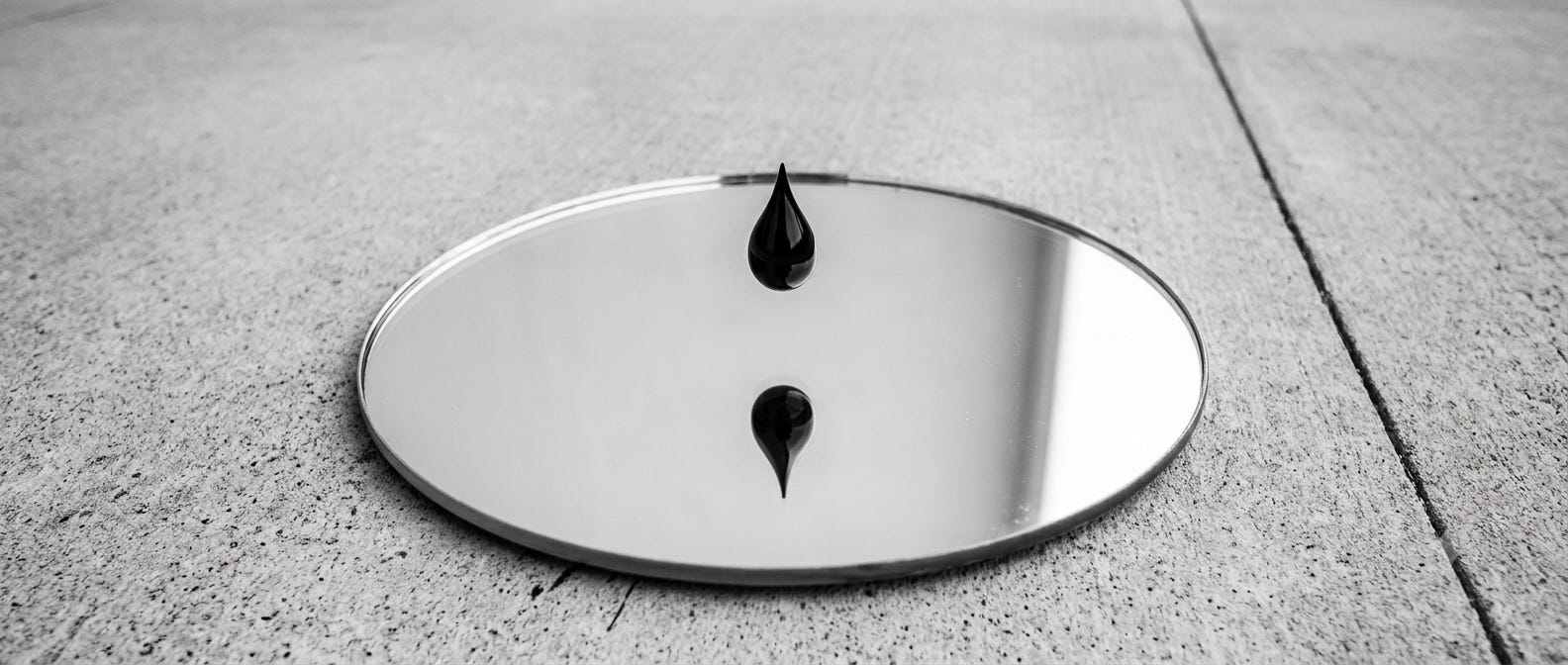
Wouldn’t it be absolutely amazing to grow with a clear understanding of what Life is?
Since I learned to read, I have been in an active exploration that has been unsatisfactory for most of my life. Until now.
I’m not saying that the process of exploration is over, that my current understanding is the pinnacle. What I’m saying is that now I’m satisfied with the answers I’ve got. That is new.
I wrote this material as a crystallization of the first 52 years of exploration. It is meant for me to be a reminder and a new foundation, and it is meant for you to become part of your own unique unfolding of Life.
To me, the questions ahead are not only pointers to answers, but all of them together and in sequence behave as a framework. Make them yours, add your own notes and answers. And feel free at any point to reach out to me to talk about this.
These are the questions:
Who Am I?
Where Is the Universe Located?
What Is Reality?
How Can I Understand What “Infinite Possibilities” Mean for My Life?
What Is the Present Moment?
Past Lives, Past Trauma, and Inherited Limitations
Why Do We Do Everything Possible to Get a Better Future?
What Is Divinity?
What Is the Importance of Symbology?
What Does It Mean to “Let Go”?
Is Life an Illusion?
1. Who Am I?
When I ask myself that question, I identify with the process of thinking and answering the question: “I am the one thinking and answering the question.”
But I found that to be inaccurate, because the answer itself can’t truly express the full answer.
My thinking process happens in my mind, and the process is affected by experience and limitations. It is my mind thinking, but my mind isn’t all me. The answer is just a description.
The most detailed description of myself, the entire story of my life, my personality, my failures, relationships, and achievements, can only be the context of my life; in other words, it can only be what my mind uses to process thoughts and describe me.
So if I’m not my mind or my personality, what else is there?
I noticed that the mind, with all its thinking and describing, can itself be watched, a thought arising, a story being told, a description forming. And whatever is doing that watching cannot be the mind itself, because the mind is what’s being watched. That noticing is what points to something else.
This is not a proof, and I want to be precise about that. It is a philosophical reflection, one interpretation of what I notice, not something the noticing itself can settle beyond doubt. But of the interpretations available to me, it’s the one that feels most honest to what’s actually happening when I look.
The processing of what happens, the narrative of what happened, happens somewhere. Some people call that awareness, others the field, others consciousness. I call it Life, though really, life is just what my mind calls it, its own word for what has no name.
I am Life happening through a unique vantage point. I perceive reality through my senses; I process the experience of reality; I interact with reality from the perspective of a personality.
I am life happening, mind processing, and the consciousness of it.
The body will age. The mind will change its opinions, forget what it once believed, grow tired of what it once liked. The face in the mirror tomorrow won’t be the face today. But the one noticing all of that arriving and passing doesn’t get older alongside it. It just keeps noticing — the same watching, whether the face is young or not.
Everything that is perceived happens in that watching. That is what I call my life.
2. Where Is the Universe Located?
As a child, I could not grasp the idea of an infinite universe. Why? Because I could not grasp the idea of infinite space: what could contain infinity?
My childhood questions were never satisfactorily answered, so I kept looking. What I found isn’t an answer so much as the discovery that the question stopped needing one.
The experience of life is real. The perceived universe, space, time, distance, scale, is real too. Nothing here denies that.
The illusion is the assumption that this is the full story: that space and time are the container, and everything else, including consciousness, must somehow fit inside them.
Materialism was the framework I didn’t know I was using — the belief that the universe is material, that it unfolds along a timeline, evolving into a future. That framework is precisely what kept me from seeing it the other way around:
The universe happens within Life, within the consciousness of the experience of life, rather than consciousness being one more thing happening inside the universe.
The universe, then, is a perception that happens in Life itself.
Everything perceived from a personal perspective happens within that same field — Life, consciousness, whatever word is reached for. It is a description of the current state of all there is, from one vantage point.
I can’t know for certain that consciousness is one, containing all perspectives at once. That’s an assumption I’m making, and I hold it loosely. What makes it feel true to me is this: through sleep, forgetting, changing opinions, growing older, something in me seems available underneath all of it; every time I’ve looked for the one who’s looking, I’ve found the same looking, not a different one. Others describe their own experience differently, and I don’t think that makes their account less honest than mine. It’s simply a different report from a different vantage point.
The possibilities are infinite. The vantage points are infinite. The universe seems vast and limitless because we’re perceiving it from within space and time, which is exactly the perspective that would make something look infinite, the way a wave can’t see the ocean it’s made of.
So the child’s question — what could contain infinity — doesn’t get answered. It gets dissolved. Nothing needs to contain infinity, once infinity is no longer assumed to need a container.
3. What Is Reality?
At this moment, my answer conforms more to the moderate, non-dual idealist position, in contrast to the materialist one, which explains reality as material existing even without anyone capable of perceiving it.
Reality, to me, is more like what happens within Life, manifesting as me living in this world.
I don’t see material reality as fundamental, because all of it is my interpretation of what I perceive, in other words, a collection of biased and incomplete narratives. All those narratives, however studied or refined, happen in my mind, like thoughts and memories. What’s fundamental, then, is being aware of them.
Of course, reality isn’t something I own. You may read it entirely differently. Reality as experienced is likely different for every conscious being — real for each of us, manifesting fresh in every present moment, but never the same reality twice, never identical between two people.
It’s easy, from here, to slide into cause and effect: what I do or don’t do now will produce a future I’ll have to deal with. But that’s just another anxiety-producing narrative, one more story layered onto the present, borrowing the same “reality is fixed and external” assumption I’ve just set down.
If reality isn’t a solid material fact but an interpretation renewing itself moment to moment, then the future isn’t something being built by my present actions so much as something that simply hasn’t been interpreted yet. I find it more freeing to say the present is unpredictable, and I deal with it as it comes, regardless of what conclusions I’ve reached about what reality ultimately is.
Reality isn’t the truth of what’s out there. It includes me, my life, and all the infinite possibilities I’m not yet aware of.
4. How Can I Understand What “Infinite Possibilities” Mean for My Life?
I used to believe that there was something I could get from an infinite-possibilities universe. I got the sense that I could do something to align with the possibilities that were good for me — I’m talking about desires.
After years of trying, I came to realize there is a difference between an infinite-possibilities universe and me having the power to manipulate it.
Then I came across a metaphor that made it click. Do you remember music CDs? Those mirror-like discs holding entire albums?
If you hold one in your hand, you’re holding all the songs it contains at the same time. But if you place the CD in a music player, the player is designed to play its contents in order, in sequence. The player is what brings the passing of time. Without it, all the songs are simply there at once, in one piece of plastic.
I see an individual life as the unique song that plays in space and time — one among infinite possibilities. But what amazes me is that the song is listening to itself. My life is the trajectory, the track, the sequence manifesting as a flow of music in the present moment, plus the consciousness of it.
I want to sharpen that image, though, because held too literally it can sound like everything is already written somewhere, waiting its turn. That’s not quite what I mean. My position is that there is no future. Not a hidden future, not a future already decided elsewhere. Only the present, manifesting, right now, one of infinite possibilities.
The past I remember and the future I imagine aren’t separate places holding fixed content; they are memories and projections, artifacts of the mind, perceptions contextualized in this present moment along with everything else being perceived. So the present is unpredictable, not because a fixed track hasn’t reached me yet, but because there is no fixed track anywhere else for it to be waiting in. Only this, manifesting, now.
Some kind of spontaneous present. Awesome!
5. What Is the Present Moment?
From the linear time perspective, the present is what intersects the past and the future. It is impossible to pin down, because as soon as we notice it, it has already become part of the past.
Linear time, to me, makes logical sense. But it also keeps me in a kind of constant battle: doing what’s needed now to secure a better future.
It’s an agrarian metaphor at heart: plant seeds for a future harvest, prepare now against a bad one.
To activate a different perspective on time, I ran a small experiment. My past is remembered as memory, in the present moment. If someone asks me what I ate for lunch yesterday, I pause, refocus my attention, scan for the memory, and respond almost immediately. I retrieve the answer now.
Something similar happens with the future. If someone asks where I’d like to travel next, I pause, remember where I’ve been, imagine an experience I’d like to have, and suggest alternatives. The future, too, is only ever imagined in the present, right after the question is asked.
From this angle, time is only ever present — never past, never future. Something like the CD metaphor again: life happens in the present, in the middle of infinite possibilities.
This doesn’t make the past and future disappear, or make their weight vanish on contact. What it changes is what that weight is actually made of.
Anxiety about tomorrow isn’t really about tomorrow — tomorrow isn’t here to be anxious about. It’s a present act of imagining, felt now, mistaken for evidence about a future that hasn’t arrived.
Seeing that doesn’t erase the feeling, but it relocates it from “something bad is coming” to “I am imagining something bad might happen, right now.” That’s a different thing to be with.
The seeds still get planted. The harvest still gets prepared for. What can change is whether the planting happens from present, clear-eyed care, or from a present moment quietly hijacked by an imagined future standing in for something that hasn’t happened yet.
6. Past Lives, Past Trauma, and Inherited Limitations
After realizing that the present moment is the only time that actually exists, the logical next question was:
What about everything that happened to me — the family ancestral baggage, the karma I supposedly embody?
I’ve read so many explanations of how the past shapes us, limits us, and how important it is to work hard unknotting the blockages holding our life back today, from Jung to modern-day teachers of every kind.
But if the only time is the present, then all of that — trauma, karma, ancestral weight, past lives — is just memory: a narrative held, consciously or not, right now. I see karma and ancestral inheritance as different forms of the same thing: not forces reaching forward from somewhere else, but memory, context I carry into this present experience.
Karma, seen this way, is an explanation from the present about the present. It’s easy, once events have already happened, to look back and draw a straight line of cause and effect between them — that’s just what the mind does with what’s already occurred.
That doesn’t make the story false. It just means the causation is being assembled now, from where I stand, not delivered intact from some other time.
That distinction matters, because there are two very different ways to relate to that context.
One is to let it become a limiting belief — a verdict, a sentence: I am this way because of what happened.
The other is to hold it as context for interpretation — this is the lens I happen to be seeing through, shaped by what came before, without it dictating what must happen next.
The past doesn’t disappear either way. What changes is whether it’s read as a life sentence or as context I perceive in the present moment. When I can see the past for what it actually is, context, arising now, I can at least partially release my identification with it.
This matters because my memories come with emotional charge, even when what I remember is inaccurate. Often what I’m holding isn’t even the event; it’s my interpretation of the event, a biased narrative dressed up as fact.
Holding a grudge against a memory is like adding thought on top of thought. It doesn’t resolve anything; it just multiplies the emotional charge, unnecessarily, in the present, again and again.
The experience of life living right now is my mind’s interpretation of the perceptions of this moment. So despite everything here about time, infinite possibilities, and past and future as forms of thought — they are as real as I experience them. They are the song playing and listening to itself. Which means there’s no judgment about where I am in the song; no verdict on whether this is the right note, the right chapter, the right pace of healing.
I lived with a grudge against my father for decades. Until a conflict brought us to speak openly, and I understood that we had both contributed to escalating an original situation.
When we saw the truth of it together, we recognized our mutual responsibility, and what happened next is what many people call forgiveness. What a relief, to finally set down a story I’d been quietly rewriting and re-charging for years, without ever noticing I was the one doing the rewriting.
7. Why Do We Do Everything Possible to Get a Better Future?
I was educated to believe I’m the architect and builder of my future, through effort and dedication. I was taught to trust my logical, rational mind to prevent harm or failure. I was often judged when I proved incapable of predicting what was coming, or preparing for adversity effectively.
We, humans, share a deep wish to be accepted by others, and that wish pushes us toward a quiet, rarely examined belief: that others accept us only when we have value to offer.
If I am not valuable to them, I will be excluded.
The problem is that “value” is never clearly defined, never adjusted to the individual for practical reasons. Conforming to the rules of the group is preferred over self-initiative.
Everyone loves the innovator who took the risk of being different, but only after they’ve succeeded.
Being accepted, being included, makes me feel like I belong, gives me a sense of legacy, and seems like the safest place to stand if I want to succeed.
But that fear of exclusion only has real teeth because of something underneath it: the belief that a future is genuinely coming, genuinely at stake, and that failing to secure it now means real loss later.
Take away the belief in a future that matters more than this moment, and “not being valuable enough” loses most of its grip; there’s no later moment left for the exclusion to happen in. So the standard interpretation of reality, time, and life — the one that treats the future as the place where the real consequences live — is what manufactures this whole architecture of anxiety in the first place.
The present moment reflection already showed the mechanism: the future is only ever imagined, right now, in this moment. What this question adds is the why — why we keep doing that imagining so compulsively, even once we’ve seen it’s imagined. And the answer seems to be: belonging. The imagined future is where belonging is won or lost, so the mind keeps rehearsing it, trying to secure a placement in a room that doesn’t exist yet.
I do like the idea of planning and envisioning as part of my relationship with reality. I think it’s healthy, even necessary, to imagine what could be better. What I’ve had to notice is the difference between imagining as a present act, and imagining as compulsive belief in my power to grant an outcome.
I’ve decided to stop trying to control the future. I must admit, though, that I need constant reminders; this isn’t a decision made once and settled.
A better future, held as compulsive belief rather than honest planning, is what makes me buy more gadgets than I need, chase more discounts than I need, always reaching for the next adjustment that will finally make the imagined future arrive. And, quietly, it’s what decreases the quality of the only life I actually have: this one, now.
8. What Is Divinity?
From the materialistic perspective of reality, we can only imagine that before we appeared on Earth, a sequence of events had to happen. A past that created the present and that keeps moving towards the future.
That perspective inevitably produces the question:
What was here before all the events that created the universe? How can something happen from nothing? Who created us?
Therefore, the materialistic perspective creates a gap, and our minds fill it with the idea of Gods or a supreme God.
I have lived my life trying to understand and find God.
But my current perspective, as I explained before, presents an interpretation of reality where the universe happens within the awareness of it; it does not originate before consciousness, because the past is a memory that happens in the present moment.
Divinity is to me what happens when the person, the mind, experiences consciousness; when the separate self falls away and recognizes itself as the whole field, rather than a point looking out at it. In other words, when the song hears itself.
Divinity is not a goal. It is the experience of an integrated reality: what we perceive as material, and what holds it, in an expanded sense of unity — the perceptions, the interpretation of the perceptions, and the consciousness of the interpretations, experienced as one, rather than as separate steps with a self standing in between.
When I listen to a live choir, I’m amazed at the beauty, and I can’t believe my luck in experiencing such beauty. But as I experience it, I’m included in it. It is no longer only me perceiving; it is me as part of the field of the experience.
When I interact with a piece of art that captures my attention, sometimes there is something in it that opens me up to a shared experience with the artist; that experience often brings tears of joy or empathy.
I believe that the divine is what holds reality, impossible to name or define, but something that shines through when we experience love and beauty.
9. What Is the Importance of Symbology?
I place this reflection here, right after divinity, on purpose. Symbols and art are, for me, one of the few reliable doors into what I called divine in the last section — not by describing it, which flattens it, but by leaving a gap the divine can slip through unnamed.
For years, I forgot about symbology. Not that I didn’t know it existed — I simply stopped including it in how I communicated. I stopped leaving deliberate gaps for others to imagine, interpret, and add their own content. I believed I had to be more and more explicit — saying, telling, describing, reaching for the right words and synonyms — and in doing that, I left the richness of symbology unattended. Explicit language felt like the more serious, more precise tool. It wasn’t.
After hundreds of public speaking events, I noticed something consistent. The people who got my message clearly walked away empowered; they introduced real changes in how they worked, how they approached their own development. But the people who didn’t get it that precisely still found the talks inspiring. They just went home without a clear sense of what to actually do differently.
For a long time I read that gap as a failure of clarity; a message I hadn’t managed to make explicit enough. Now I read it differently. Some of what I was trying to communicate simply can’t survive being made fully explicit; I could have enriched the experience by including symbolism.
Symbols carry a kind of meaning that resists complete translation into plain language; something is always lost the moment you try to explain a myth, a piece of art, a story, down to its literal content. That’s different from a code, which can be fully decoded without loss. A symbol only partly gives up its meaning when explained; the rest has to be met, not told.
Consider a short list of images, without explanation:
A family hugging, reunited at a train station. A newborn receiving a mother’s embrace for the first time. A child bringing a daisy to a grandparent. Someone publicly, unguardedly expressing joy. A minimalist wooden cabin, a fire lit in the chimney. Ocean waves, undisturbed by any other sound. Frodo volunteering to carry the Ring to the fires of Mount Doom.
None of these tell you what to think. What each one stirs in you depends entirely on your current state of mind. Grief might find one of these unbearable and another comforting; joy might light up a different one entirely. The meaning you add, through your own imagination and reflection, is what makes the image alive. That aliveness is symbology’s actual territory, the same territory that pointed to divinity earlier: not a fixed message delivered, but something recognized, co-created.
That’s the actual importance of symbology: it’s a universal language that goes beyond words, carried in art, mythology, and storytelling, capable of transmitting exactly the kind of meaning that explicit language flattens or loses. It doesn’t compete with explicit language — it does something explicit language structurally can’t.
But this cuts both ways. Being aware of the symbology at work in a message can also reveal the intentions behind it.
A marketer running an ad full of healthy, well-dressed, happy elders buying lottery tickets isn’t just showing a scene — they’re reaching for an insecurity in their audience, using the implicit pull of the image to persuade what a plain sentence (”buy a lottery ticket”) never could.
Symbolism’s power to bypass explicit reasoning is exactly what makes it useful for connection, and exactly what makes it useful for manipulation. Understanding it doesn’t just make communication richer. It makes a person harder to quietly move.
I understand communication as a kind of mirror. The emitter sends a message; the receiver interprets it from their own point of view, and in doing so, creates the meaning. The meaning of the message, in the end, is more a reflection of the receiver than of the emitter.
Language is explicit; symbols are implicit — they call for the receiver to add meaning themselves. And that’s not a flaw to correct with more precision. It’s the mechanism working exactly as it should. Understanding that has changed what I try to do when I speak or write. I’ve stopped trying to control what lands. I leave the gap on purpose now — the way a mirror doesn’t argue with what it reflects.
10. What Does It Mean to “Let Go”?
In a moment when I’m struggling, I usually look for information, wisdom, or teachings that can help me see what I can do to reverse the situation. Many times I meet the concept of “letting go,” but I just could not grasp its meaning.
Letting go of what? How do I find the source of the problem? Or is it that I should just abandon my desire to not struggle?
One idea that brought me closer to an understanding was: “Trust in the process.”
I interpret that as a kind of faith in the intelligence of the universe itself. An unconditional trust in a Universe that brought me here to be alive. Everything in the past happened to create the conditions for me to come to life. How can that incredible process be wrong? I must trust the process.
But soon after, when my experience of life brought me to another struggle, I found that trying to trust the process didn’t change anything. I stopped taking action, started waiting for something to come my way and save the moment. I started secretly asking the Universe for relief.
Was I letting go, or was I delegating responsibility to another entity, the Universe?
Looking back, the attitude I had made a separation between me, the universe, and the circumstances. I was struggling because a circumstance beyond my power affected me, and from a position of powerlessness I asked the universe, as if asking another person, to intervene.
Had I made myself a victim of a situation in a universe that is indifferent to me?
Not letting go, then. Delegating.
On the previous questions and answers, I explained that now I see who I am from a different perspective. From that perspective, the Universe, me, my feelings, perceptions, emotions, and interpretations happen within the field of consciousness. And if you remember the metaphor of the music CD that contains the entire playlist, the infinite possibilities, although the songs are already set. In other words, my life is what unfolds in the present; it is the part of the song that is playing now.
In that now, all the decisions I make, all the thoughts and strategies, introspection, and healing are different words for the interpretation of reality. The decisions feel like agency, the denials feel like resistance, the struggling feels like friction. But all that is the current melody playing.
From this perspective, there is nothing I can do to change the song as it happens. Me, the person interacting with the rest of reality, can’t do anything to change what comes to the song.
From the perspective of the separate self, past, present, and future, we feel that we have agency through our decisions, and we get the feeling that our actions influence what’s to come next. But each time our expectations aren’t met, we feel disappointed. When things go as expected, we validate that our previous actions produced the right results, but in a similar circumstance, a similar decision can produce a different outcome. That’s what I call the illusion of self-determination.
Letting go, then, is letting go of that illusion of control.
Once I let go of all the illusions, all the noise, I can experience reality with more ease, less trying. Although a sense of “I don’t need to do anything” emerges, it becomes obvious that Life is unstoppable, and change will invite action.
Letting go is itself an experience that happens, even though, from inside, it feels like something I’m doing. That doesn’t make the doing false. It just means the letting go is one more part of the song playing, not proof of me doing something positive that will bring something positive in the future.
I find it very important to note that coming to this perspective and realization is not to be seen as a goal to achieve. It is just the part of the song that is playing now in my life. From your perspective, what this text brings to you is your part of the song; there is nothing you must do other than perceiving and experiencing your song as it is unfolding.
Letting go feels like accepting everything as it is, even when it feels wrong.
11. Is Life an Illusion?
I believe that life as perceived by a human is a perspective that contains infinity. The universe is relational, and as Carl Sagan once said, to have an apple pie, we need to invent the Universe. Nothing can be without everything else — every apple, every atom, every moment implicated in all the others.
To me, Life with capital L is the unfolding of that perspective in the eternal present, experienced through a prism that is I.
Sagan didn’t mean what I mean by what I said above. He was a committed scientific materialist, and his apple pie was about causal interdependence inside a single, linear, physical timeline; not an argument that consciousness comes first. I don’t think that makes his reading wrong. I think it makes it his vantage point, bounded the way every vantage point is bounded. From where he stood, inside linear time, he likely couldn’t see what I’m calling the eternal present; not from a failure of rigor, but because every view, including mine, only sees as far as where it’s standing allows. My interpretation isn’t truer than his. It’s simply mine.
The theories of the universe as a simulation, a hologram, seem to me similar to the story of a Divine Creator, just adapted to modern terminology. It is not the God that made Man with clay, but a God that made the universe with computers. Either way, I see both stories as symbols pointing at the same idea: the materialistic vantage point requires causation — something must have created reality — but that requirement collapses the moment you ask what created the creator. Imagine the computer running the simulation of the universe. Now ask: who made the computer? We’re back to the original problem, one layer further down.
As Rupert Spira says, illusions exist. They are perceptions and interpretations; it is just that they are not what they seem to be. I would say that what we call reality is a limited interpretation of an infinite reality, and that interpretation, made by one human, fades away the same way thoughts or clouds in the sky do. I’d dare to say the interpretation of reality is illusory — but reality itself isn’t.
Life as I experience it is something I’m aware of. It exists as it is, and that is proof that Life is not an illusion. The contents of it are simply how Life experiences itself.
Conclusion
In the past few months, I have been rediscovering the meaning of art in my life. I want to see my work and strengths as tools to create artistic expressions. Art is beauty, and it feels humbly powerful.
Even if the art form expresses sadness, it points to empathy. Even if it expresses the natural beauty of our world, it points to you living in it. Art, as an expression of our most tender and vulnerable aspects, manages to master implicit and explicit messaging to act as perfect mirrors of who we truly are. Art is what can break the boundaries of our beliefs to reveal the shining love that rests within ourselves. That is where healing, forgiveness, compassion, inclusion, and interdependence live, not as tactics for a better future, but as facts and divine realization.
Art is the potential of our creativity, when our actions aren’t exclusively the result of conditioning.
To be honest with you, I can’t see myself as an artist yet, but I see the potential. I want to see what I do as a deliberate process of mastery — deliberate, but held with some kind of beginner’s mind. Not wanting mastery to arrive someday, so I can finally rest. Just naming, honestly, what this present moment happens to want.
Why? Because right now, that’s the song I’m listening to.
Now that this text is part of your song, I wish it brings you closer to yourself.
Love,
Jose.
You can also interact with a NotebookLM loaded with this article and other interesting resources. That means you can ask questions and expand your exploration.
Appendix: Where These Ideas Sit
None of what I’ve written arrived from nowhere. Long before I found the words for it, other people had already walked parts of this path, and it feels honest to say so.
The closest company I’ve found is Advaita Vedanta. This tradition first gave me language for a witnessing consciousness that doesn’t change the way its contents do, and for maya not as something false, but as something real yet incomplete, mistaken for the whole. Rupert Spira, whom I quote directly in these pages, works in that same lineage, and reading him felt less like learning something new and more like finally hearing my own experience described back to me. Bernardo Kastrup’s writing on idealism sits close by too — his argument that consciousness is the one substance, and the physical world its appearance rather than its foundation, is nearly the claim I make about reality and the universe, just built from a more analytic direction than a contemplative one.
Spinoza, oddly, turns out to be a quiet ally in the chapter on letting go. He wrote that freedom is the understanding of necessity — that we are not free because we escape causation, but because we stop suffering under the belief that a separate self was forcing outcomes into being. I didn’t set out to agree with a seventeenth-century rationalist. But that’s exactly the shape of what I mean.
Taoism’s wu wei is the same teaching worn differently: not the absence of action, but action without the private grip of someone needing to own the result. I first met the idea through Alan Watts, and it gave me almost as much trouble as letting go did — the same difficulty, dressed in different words, arriving from a different direction.
I also want to be honest about where this parts ways with traditions I hold dear. Buddhism, which has shaped me as much as anything else, doesn’t actually agree with Advaita on the point that matters most here. Advaita says there is a permanent witness beneath all the changing content. Buddhism says there is no permanent anything — not even the witness. I’ve drawn from both, and I notice I’ve quietly sided with Advaita on this particular question, even while Buddhism’s teaching on impermanence and non-self runs through nearly everything else I believe. That’s worth naming rather than smoothing over.
Physicalism — the view most working scientists and philosophers of mind actually hold — would reject nearly everything in this booklet at the root. Not out of closed-mindedness, but because, from inside that framework, consciousness is what a brain does, not a field the brain appears within. Daniel Dennett went further than most physicalists and argued there isn’t even a single witness to find — that what feels like one continuous observer is closer to many competing processes, with no one seated anywhere. I don’t share that view. But I don’t think it’s foolish, and I don’t think the people who hold it have failed to look closely enough. They’ve looked closely and seen something different.
Classical theism — the God of Aquinas, of mainstream Christianity, Islam, and Judaism — would also part ways with me, specifically at the question of divinity. That tradition insists God is not identical with anyone’s expanded recognition of consciousness; God remains wholly other, Creator distinct from creature, however close the mystics within those same traditions have sometimes come to describing something that sounds remarkably like what I mean.
I mention all of this not to win an argument, but because I think it matters to say clearly: what I’ve written here is a vantage point, not a verdict. Sagan saw the universe through a materialist, linear-time lens, and from where he stood, that was simply what was there to see. I don’t think that makes him wrong. I think it makes him bounded, the way every vantage point is bounded — mine very much included. If you read this and land somewhere else entirely, that isn’t a failure of the book, and it isn’t a failure of you. It’s just what the view looks like from where you’re standing. That, more than any single answer in these pages, is the thing I actually believe.
These are very very deep questions, Jose. We don’t have all the answers but at least we are collectively trying through such musings. Thanks :)
I’ve spent years believing that if I thought hard enough and planned far enough ahead I could somehow stop the bad surprises. Running businesses cured me of that one fairly quickly.