
Wait, have we turned the wrong corner with AI?
Revisiting technology, craft, and independence

I’m starting to believe that we got something of AI wrong.
Most of us see the technology as an opportunity to improve our work, become more efficient, and compete in the market more effectively. Do you remember? Most of us said, “We will use AI as a tool.”
But there is something we didn’t say as clearly: what are we not going to use it for?
The poll above can be used as a non-scientific point of reference.
There are trends that not many people talk about, and I’ve heard them firsthand.
One of my friends was hired as part of a team, one human and multiple agents. His job is to adjust the technology so it produces the outcomes described in the tickets he receives. He takes responsibility, designs the system, adapts it to each ticket, and his agents deliver the result. Low interaction with other humans. The entire process is documented automatically. Every change and improvement gets stored and analyzed. I see it as a form of domain knowledge extraction.
Another friend is in contact with a large company that recruits specialists to train AI models for very specific industry needs.
They pay good hourly rates — and I believe they factor in our tendency for short-term thinking. Otherwise, any applicant would dare to ask: why would I spend time letting AI absorb all my knowledge, only to be replaced by it? The hourly rate has to be good enough to silence that question.
The current business paradigm is built on extraction. The theory goes that transforming raw materials and resources, including human labor and intelligence, produces profits, progress, and innovations that can then deal with the consequences. We all participate in it: competing for better income, grinding toward a better future, learning what we need to survive and thrive.
But here is where I think we took the wrong lane.
One thing is that an individual uses tools to gain efficiency, to do more in less time. A completely different thing is what an AI company, a billionaire, or a powerful country can do with the same logic.
If humanity — at every level — applies the same extraction model for business and power, what we are doing is accelerating the collision between competing parts. Conflict.
When we see others as the enemy, they see us as a threat. It becomes a difficult cycle to break.
Weaponizing AI, in other words, using it as a power-grabbing tool, seems wrong to me.
US vs. China. Musk vs. Altman. It seems natural to hear leaders at Anthropic or Google say that what they care about most is protecting American interests. It makes sense to see AI companies racing toward AGI, so they can be the ones bringing it to the entire planet, for the ‘benefit of Earth and the human race’ in a similar way Meta says it does: “…to give people the power to build community and bring the world closer together…”.
But how is all that possible, for American companies, if America comes first? (We can apply other names of countries, corporations, and individuals).
If we are using AI as a tool for power harvesting and competition, “we are aiming beyond the toilet” entirely.
Why? Because the ones with more money and more power will always have the advantage. Ask the majority of retail crypto investors…
Soon enough, AI models will be far easier to use, and any edge the early adopters have will evaporate. We will be nudged to keep upgrading, keep subscribing, keep chasing the newest features.
We rarely stop to think about what mass adoption actually means. We can’t easily grasp what happens when a billion people use the same tool with the same proficiency. There is no advantage in knowing how to use Word or PowerPoint anymore.
New features arrive. We rush to learn them, to be first. We don’t notice that this is how dependencies are built — in tools, in belief systems, in communities that validate each other for doing the same thing.
I paused to ask myself why I’m not feeling that enthusiastic anymore. It started when the pathetically needy OpenAI jumped to accept the Pentagon’s deal.
But let me turn the dial down and tell you one more thing, what my 23-year-old son said to me about how he plans to build his career and thrive in this strange world.
To make it short:
Paraphrasing, “AI is a tool that simplifies work. I don’t want simplification, I want mastery”.
He wants to add complexity to his workflow so the outcome is unique, original, his, and impossible to imitate. He plans to reduce dependencies. He even intends to build some of the tools he needs himself.
He recognized that AI removes him from his art, from developing a craft, and that the dependencies it creates could cost him more than he gains. Think about what Adobe subscriptions....
The wisdom of the young is something we need to pay attention to. They are rebellious enough and fresh enough to see circumstances with more clarity.
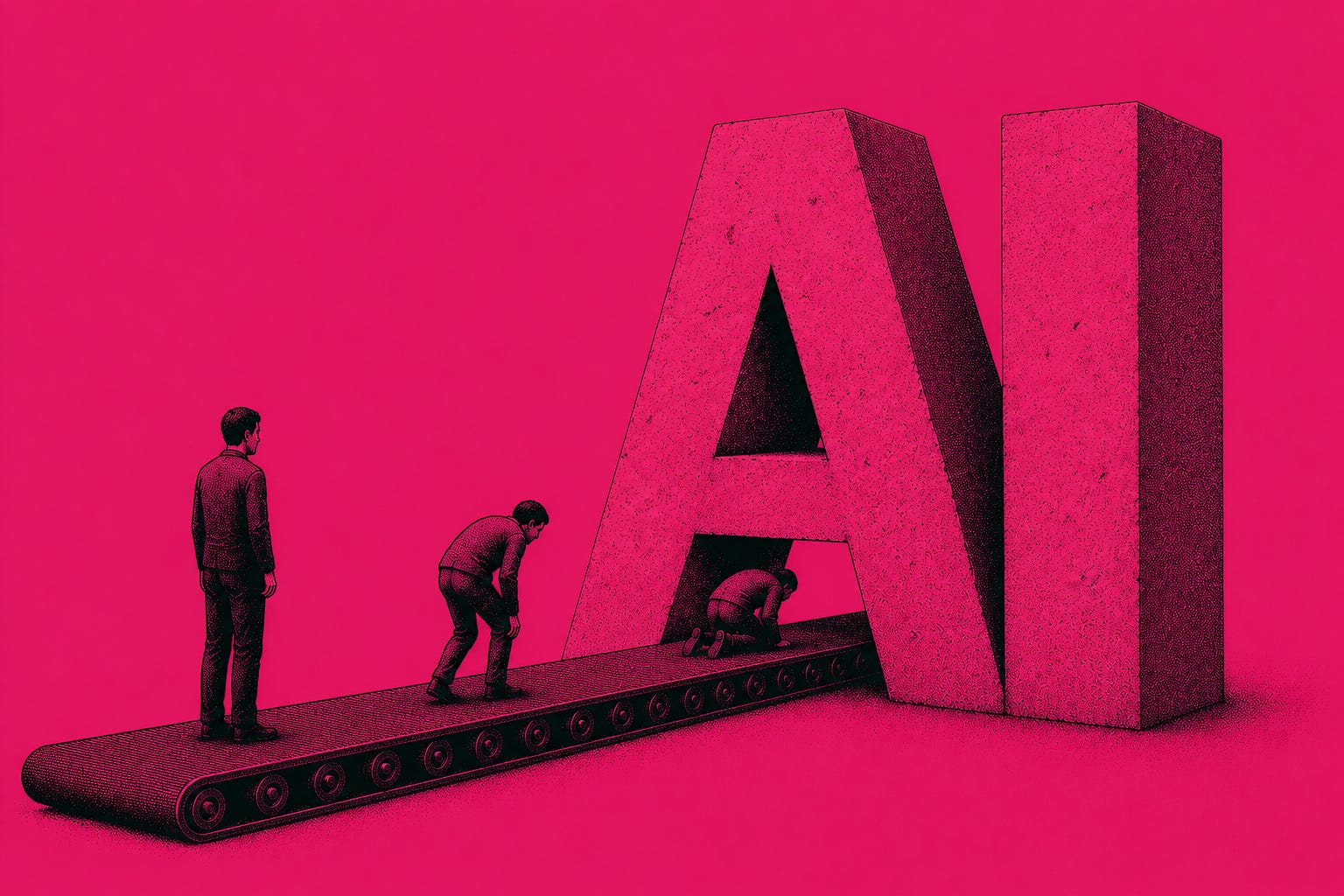
While most of us rush full speed onto a conveyor belt of standardization, believing we are doing it out of freedom and choice, there are others who see that the rush itself is a signal. When everyone races for the gold, the gold is usually already gone.
And yet, here I am, using AI to help me write this piece, asking myself about my craft, my art, and how to make any of it viable as a business. I’m revising my view on the use of technology and AI, so it makes sense to me, where I think it is valuable and can help me improve my craft.
I will avoid easily jumping into trends, especially if they are digital businesses of somebody else. I will look for ways of breaking dependencies and building processes that include the real world.
I’m not saying the creator economy is unreachable or unrealistic. What I’m saying is that for what I do, how I do it, the values I hold, and the experience I carry, the digital world is not yet the space where I can realize my original vision.
For the past month, I have been reviving some of my older business relationships in real-life encounters, and I can already feel the ripple effect. That is not a surprise. But it is very good news.
If you think I’m suggesting pausing and taking a step back before moving forward with AI, you are right.
We think of technology as the innovations that help us work more efficiently and productively, but the etymology of the word suggests something else. Technology comes from the Greek techne — art, craft, skill — and logos — reason, logic, language. Together: the craft of expressing creativity through reason. Technology was never about the tool. It was about the mastery of producing art.
I sincerely hope this article inspires you to evaluate how to get the best out of your technological tools. If it adds something to your perspective, I’ll be very happy!
Love,
Jose.
Mastery will always outlast the tool that tried to replace it.