
LinkedIn and Substack: Two Pieces of Your Creator Strategy
The one resource you need to refresh your relationship with LinkedIn


I must admit: I just don’t get LinkedIn.
I have a strong resistance to it, though I suspect that’s more bias than reality. After becoming an active Substack user, I couldn’t help comparing the two. But then I met Melanie Goodman , and everything clicked—I’d been working with incomplete information about how the platform actually works.
If you struggle with LinkedIn as I do, you’d probably love an expert’s perspective on your experience. That’s exactly what this post is: me presenting my case to Melanie for inspection and feedback.
The first part is my take on LinkedIn versus Substack—useful for finding common ground or disagreement with your own experience. The second part is where you really learn: Melanie’s perspective from someone who has actually succeeded on both platforms.
Don’t forget to use the AI Prompt I share at the end. And let me know how your experiments go.
Shall we start?
This article adjusts to the following pillars of this publication: Impact and Tools.
My take
Do you find LinkedIn effective for social networking?
I’ve spent years feeling incompatible with LinkedIn. Turns out, I wasn’t the problem; the platform was just wrong for my content.
I’ve met many people who have given up on LinkedIn, can’t quite figure it out, or post occasionally just to “stay visible.” I have a friend who falls into this group… you know, ‘that’ friend 🤐
About six months ago, I decided to run one last experiment. I started using Substack to test a lingering doubt: maybe it really is me, maybe I’m incompatible with social media altogether.
I’m happy to report that wasn’t the case.
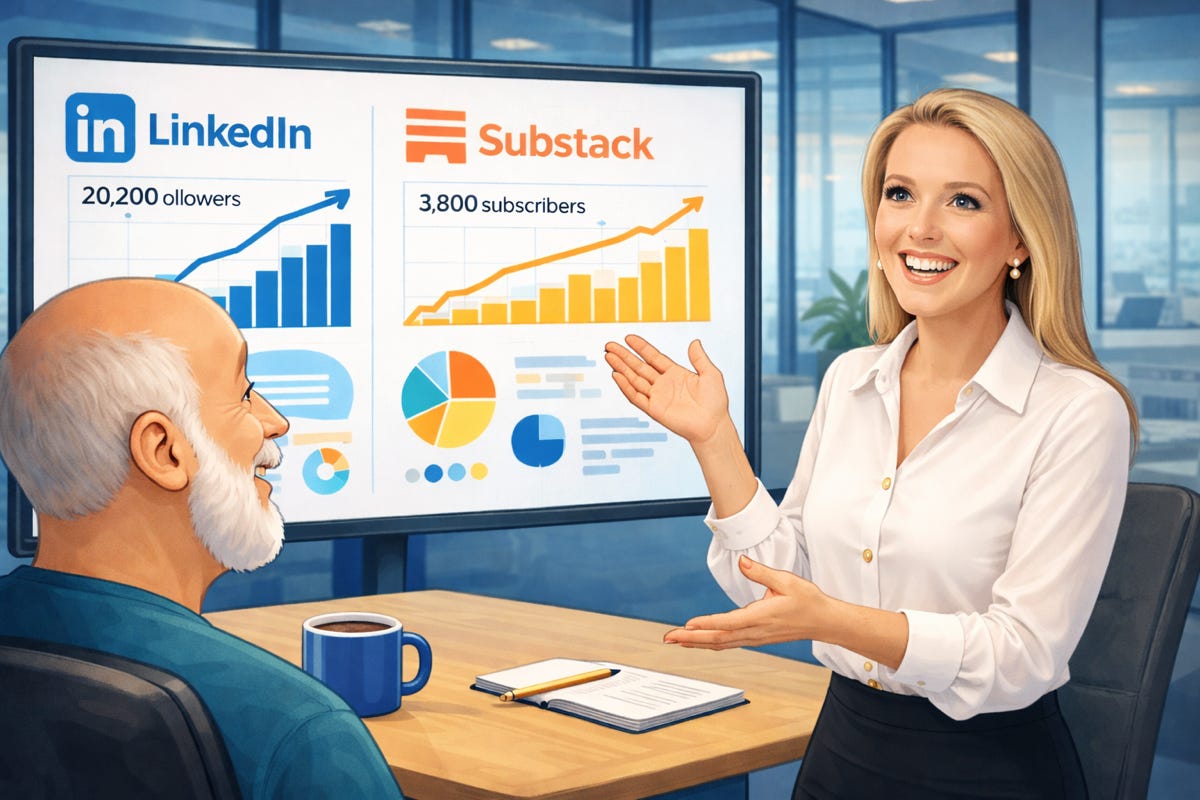
My newsletter, previously hosted on Kit.com, stayed at around 100 subscribers for more than five years. After moving to Substack, it grew to over 1,700 subscribers in six months, with more than 2,400 people in my broader network. Monetization has started, and more importantly, I’m reaching far beyond the circle of influence I ever had on LinkedIn.
For context, I have over 3,000 connections on LinkedIn. For two years, I posted consistently—at least twice a week, sometimes daily. I experimented with different formats: personal stories, professional insights, polls, and questions. No matter my efforts, my posts rarely traveled beyond a very limited circle. It often felt as if the platform constrained reach based on location, existing connections, and the type of content being shared.
And I’ll be honest: the topics I enjoy exploring are diverse, sometimes philosophical, and often fall under what some dismissively label as “soft skills.” I’m sure I caused at least a couple of headaches for the LinkedIn algorithm.
So if your content resembles mine, and you feel stuck or invisible on LinkedIn, there is hope. Try Substack.
What I discovered: LinkedIn vs. Substack
Let me compare what I experienced on each platform as two different approaches to building an audience.
On LinkedIn: I spent hours crafting posts, engaging with comments, and trying to decode what the algorithm wanted. You have a profile, a feed, tools for jobs, messaging, groups, and newsletters. But nothing works well if your content doesn’t generate enough traction for the algorithm to show it to more people.
The relationships felt transactional; every interaction was calculated to increase visibility. Managing your feed, your business presence, and participating in groups meant juggling different strategies, different content types, and maintaining a constant focus on practical value propositions. It felt like a full-time job.
On Substack: You start with a Publication—that’s your newsletter engine and the core of everything. The tools around it are designed to help distribute your content: a messenger app, easy monetization, podcasting capabilities, and Notes (which works like a social media feed for shorter posts).
Yes, it’s still transactional; people subscribe because they value what you write. But the platform facilitates a culture of collaboration. It’s easy to share quotes, recommend other writers, and cross-promote. Even monetization is flexible: I can create a Chat thread exclusive to paying members, or put a paywall on just part of an article.
I write what matters to me, publish it, and the platform helps me find readers who actually want that content—not through algorithmic luck, but through genuine discovery and recommendations.
The real difference: LinkedIn users want actionable professional value delivered quickly. Substack readers want depth, exploration, and authentic voice delivered to their inbox. Same writer, different audiences, different expectations.
I’m not saying that growing a network on Substack is easy. But it is easier than on LinkedIn, at least for the kind of content I create. That’s why I’m still here, six months later, writing to over 1,700 people who chose to hear from me.
One challenge I’ve noticed: Most publishers and content creators use the Substack apps more actively than subscribers do. That can make interaction between subscribers and the platform more complicated than it should be. But it hasn’t stopped the growth.
Melanie, over to you.
I’ve laid out my experience as honestly as I can. I know you’ve succeeded on LinkedIn in ways I haven’t, and you’re also growing on Substack. If you find something that I’m missing here, or something you’d like to add, the floor is yours.
Melanie’s perspective
I think you’ve captured the difference in intent really clearly, and I agree with most of it. LinkedIn is optimisation-heavy by design; it rewards speed, relevance signals, and repeat visibility, which is why it can start to feel like performance rather than conversation. Substack feels slower because it is built around consent first, inbox second, and discovery last.
What I’d add is that LinkedIn works best when you treat it as a relationship layer, not a publishing destination.
Substack is where people settle in. LinkedIn is where they notice you. Used together, they serve very different cognitive modes: Quick signal versus sustained attention.
One useful data point here: LinkedIn posts have an average content half-life of around 24 to 48 hours, while email newsletters are often opened days later and revisited. That alone shapes behaviour on each platform.
The question for me isn’t LinkedIn or Substack, it’s what kind of thinking are you asking people to do with you, and where are they mentally prepared to do it?
Picking up on your comparison, I think the real difference lies less in features and more in intent at the moment of reading.
On LinkedIn, people arrive already scanning. They are between meetings, on a train, or procrastinating for three minutes. That is why posts either land fast or disappear fast.
Practical tip here: treat LinkedIn posts like conversation starters, not finished thoughts. Leave something unresolved so people reply, because comments are what extend reach beyond the first 48 hours.
On Substack, the intent is calmer and more deliberate. People open emails because they choose to.
Practical tip: write as if you are speaking to one person, not an audience. Depth works because attention has already been granted.
Another overlooked point is relationship direction. LinkedIn relationships are often many-to-many and weak ties. Substack is one-to-many but emotionally stronger. That means LinkedIn is excellent for discovery and signalling relevance, while Substack is better for trust-building over time.
For me, the sweet spot is letting LinkedIn surface who might care, then letting Substack do the job of why they stay.
Note to self: don’t forget…
… One big piece that often gets missed in the LinkedIn vs Substack conversation
is SEO.
LinkedIn content has a very short discoverability window. Posts surface for days, sometimes a couple of weeks if comments keep them alive, but aside from newsletters, they are not built to rank meaningfully on Google. Practical reality: once the feed moves on, the content effectively disappears unless someone already follows you.
Substack is the opposite. Your posts are indexed like blog content, titles matter, structure matters, and older pieces can quietly bring in new readers months or even years later through search. That compounds. One well-written article can keep working while you sleep.
A practical tip here: on Substack, write headlines people would actually search for, not clever ones. Think questions, problems, and phrases your reader would type into Google. On LinkedIn, optimise the opening two lines for human curiosity, not search engines.
Data backs this up. Around 68 percent of online experiences still begin with a search engine, and email or blog content consistently outperforms social posts for long-term traffic. That makes Substack closer to an owned media asset, while LinkedIn remains a distribution layer.
So LinkedIn gives you speed and visibility. Substack gives you longevity and search-driven discovery. How deliberately are you writing for future readers versus today’s feed?
Thank you for the opportunity to contribute!
A tactical summary
After hearing Melanie’s perspective, here’s what I’m taking away, and what you can use immediately:
For LinkedIn:
Treat posts as conversation starters, not complete thoughts
Optimize the first two lines for curiosity, not search engines
Leave something unresolved to generate comments (comments extend your reach beyond 48 hours)
Use it for discovery and signaling relevance
Content lifespan: 24-48 hours
For Substack:
Write headlines people would actually search for
Write as if speaking to one person, not an audience
Structure content for depth—attention has already been granted
Use it for trust-building and long-term discovery
Content lifespan: months to years through SEO
The strategy: Let LinkedIn surface who might care. Let Substack explain why they should stay.
Try this AI prompt
A practical tool: Adapting content across platforms
If you’re creating short-form content for both platforms, here’s a prompt you can use with AI to adapt the same idea for each:
"Help me create two versions of the following text:
[paste your text here]
1. A LinkedIn post (150-250 words) that opens with curiosity, leaves something unresolved, and encourages comments. Optimize the first two lines to hook someone scrolling between meetings.
2. A Substack Note (100-200 words) written as if speaking to one person who has already chosen to follow me. Make it feel like a genuine insight or observation, not a call to action. Focus on depth over urgency."
The same thinking, adapted for two different moments of attention. That's the real insight here.
Love,
Jose.
 | A guest post by
|
Great article! I’ve been on LinkedIn for a long time, but honestly, I wasn't really using it to post; I mostly used it to keep up with news or interesting articles for my research work, specifically in the field of Data Science and Taxation—more of a Tax Tech focus, you could say.
When I stumbled upon Substack (thanks to LinkedIn, actually!), I loved it and it really sparked my interest in writing. Now, I’m using LinkedIn to promote my Substack—though I’m not quite sure if it’s working yet, haha!
This is a great article. I have been working on my job as a Community Manager using Linkedin and Substack to reach others for our newsletter, The CMO Brief. This will absolutely help. Looking forward to using the prompt. Thank you, Melanie! I just started my own personal newsletter as well!